The enduring legacy of ecumenical councils
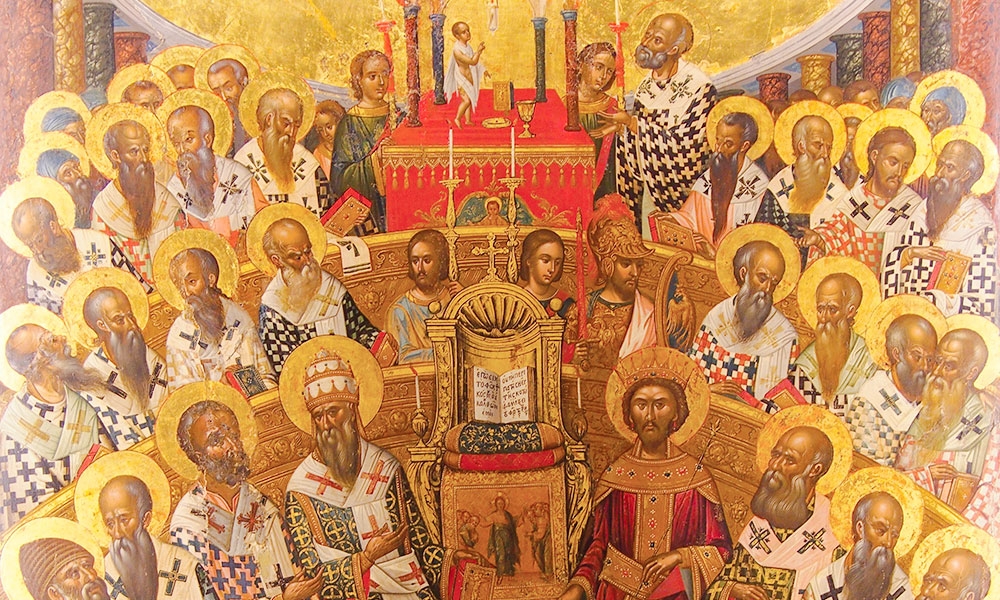
Whenever faith, morals or Church discipline are in serious question, ecumenical councils have gathered bishops from the Universal Church to provide clarity and resolution on these issues. The councils get their name from the Greek word oikoumene, meaning “the whole inhabited world.”
These councils have been part of the life of the Church from its inception. For example, the Acts of the Apostles (chp. 15) recounts the story of the very first “ecumenical” council, the Council of Jerusalem. Generally referred to as the Apostolic Council, this council brought together Peter, James, Paul and Barnabas to address whether Gentile converts in the early Christian community should be required to observe Mosaic Law.
Whenever faith, morals or Church discipline are in serious question, ecumenical councils have gathered bishops from the Universal Church to provide clarity and resolution on these issues. The councils get their name from the Greek word oikoumene, meaning “the whole inhabited world.”
These councils have been part of the life of the Church from its inception. For example, the Acts of the Apostles (chp. 15) recounts the story of the very first “ecumenical” council, the Council of Jerusalem. Generally referred to as the Apostolic Council, this council brought together Peter, James, Paul and Barnabas to address whether Gentile converts in the early Christian community should be required to observe Mosaic Law.
The authority of ecumenical councils
The decrees of ecumenical councils are binding on all Christians. Because the teachings of an ecumenical council represent all the bishops of the world (including the pope, the Bishop of Rome), they are protected from error by the Holy Spirit. While the charism of infallibility does not extend to disciplinary matters, which are by their nature changeable, ecumenical council decrees have supreme authority.
Interestingly, of the 21 ecumenical councils since the Apostolic Council in Jerusalem, most Christians, including Protestants and Orthodox, accept the first 3 to 7 ecumenical councils, but for different reasons. Broadly speaking, Protestants, who accept only the authority of Scripture, accept these councils on the grounds that they teach authentic biblical theology. In contrast, Orthodox churches, for whom the role and authority of the pope have long been controversial, view the councils after the seventh, the Second Council of Nicaea (787), as basically Western councils. With some exceptions, Eastern bishops and patriarchs did not participate in councils convened by the Catholic Church after the Great Schism in 1054.
An enduring legacy
The fruits of the ecumenical councils continue to define and shape the Church’s understanding and practice of the faith today. For example, the Council at Nicaea in 325 defended Christ’s divinity against the claim that Jesus was a creature, albeit the highest creature. Nicaea confirmed in its creed that Jesus is “Light from Light, true God from true God, begotten not made, consubstantial with the Father.”
The Council at Constantinople (381) affirmed the divinity of the Holy Spirit and completed the creed formulated at Nicaea, which we continue to recite every Sunday at Mass. The Council at Ephesus (431) declared Mary as the Theotokos (God-bearer) in response to the Nestorian heresy, which argued that Mary was the mother of only the man Jesus, not the divine Christ. Though not the source of Jesus’ divinity, the council decreed Mary was the mother of the whole person of Jesus, human and divine. The rich heritage of Marian devotion in the Church owes much to this particular council.
Many practices or teachings we take for granted today flow from decisions made at ecumenical councils long ago. For example, we are able to have statues and icons in our churches and homes because the Second Council of Nicaea (787) condemned iconoclasm, a heresy that held that creating and venerating sacred images constituted idolatry. In speaking about the Eucharist, we often use the word transubstantiation – not realizing that it was the Fourth Lateran Council (1215) that gave us this language to describe how Jesus’ Real Presence is made available to us in the Eucharist.
Some councils help to reform the Church and refocus us on our central mission. Held in response to the Protestant Reformation, the Council of Trent (1545–63) affirmed the efficacy and centrality of the sacraments, papal authority, and the veneration of saints. It also put an end to the selling of Church offices and indulgences. It reaffirmed that we are saved by grace through faith, and established seminaries for the training of priests.
Of course, the most recent ecumenical council was the Second Council of the Vatican (1962–65). Vatican II sought to bring the Church into closer dialogue and presence in the modern world. To do this, its approach consisted of aggiornamento (updating, bringing up to date) and ressourcement (a return to the sources). The council produced such notable documents as Lumen Gentium, Gaudium et Spes, Dei Verbum and Nostra Aetate. The work of implementing the Second Vatican Council continues to this day, as Pope Leo XIV recently announced a catechesis series on Vatican II for his Wednesday Audiences.
The Ecumenical Councils
- Nicaea I (325)
- Constantinople I (381)
- Ephesus (431)
- Chalcedon (451)
- Constantinople II (553)
- Constantinople III (680-81)
- Nicaea II (787)
- Constantinople IV (869–70)
- Lateran I (1123)
- Lateran II (1139)
- Lateran III (1179)
- Lateran IV (1215)
- Lyon I (1245)
- Lyon II (1274)
- Vienne I (1311–12)
- Constance (1414–18)
- Basel, Ferrara, Florence, and Rome (1431–45)
- Lateran V (1512–17)
- Trent (1545–63)
- Vatican I (1869–70)
- Vatican II (1962–65)
Pope John Paul II on the “newness” of the Second Vatican Council
“The Second Vatican Council is often considered as the beginning of a new era in the life of the Church. This is true, but at the same time it is difficult to overlook the fact that the Council drew much from the experiences and reflections of the immediate past, especially from the intellectual legacy left by Pius XII. In the history of the Church, the “old” and the “new” are always closely interwoven. The “new” grows out of the “old,” and the “old” finds a fuller expression in the “new.” Thus it was for the Second Vatican Council and for the activity of the popes connected with the Council, starting with John XXIII, continuing with Paul VI and John Paul I, up to the present pope.” (Tertio Millennio Adveniente, Nov. 10, 1994)
Doug Culp is the chief operating officer for the Pontifical Mission Societies of the United States.