The Documents of Vatican II
This is the first of a series examining the continued relevance of Vatican II documents in Catholic life today.
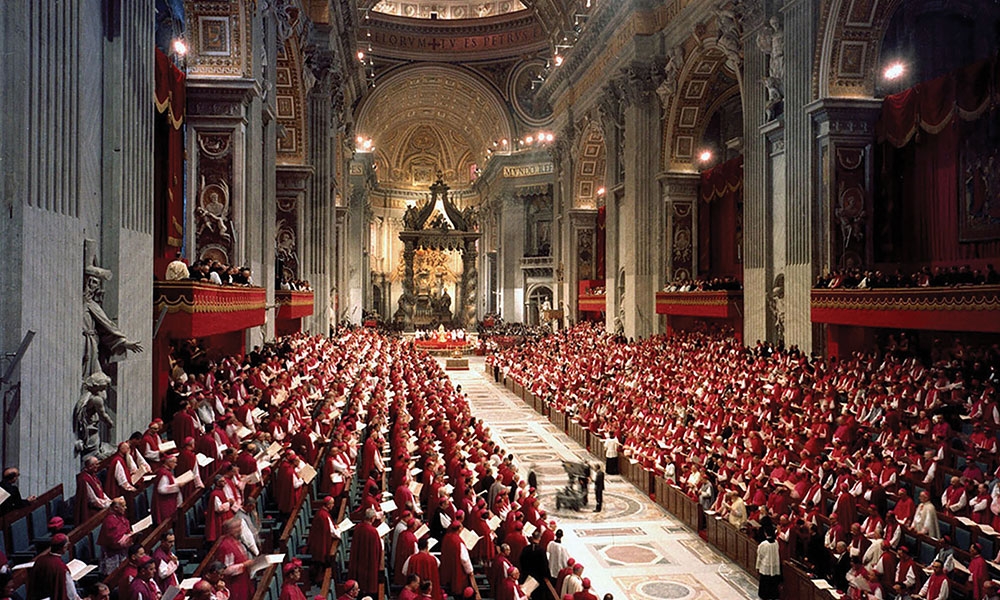
The Second Vatican Council (1962–65) remains the most significant event in modern Catholic history, producing 16 documents that reshaped the Church’s relationship with the world. These documents, however, do not all carry the same weight and purpose. The Council Fathers organized their teachings into a specific hierarchy to reflect each document’s foundational depth: constitutions, decrees and declarations. The Council produced four constitutions, nine decrees and three declarations.
Foundations
The Second Vatican Council’s four constitutions form the bedrock of the Council’s teaching. These constitutions carry the highest level of authority as they address the most essential elements of the Catholic faith: how we pray, what we believe about the Church, how God reveals himself and how we interact with the world. The two dogmatic constitutions (Lumen Gentium and Dei Verbum) deal with unchanging truths of the faith. The pastoral constitution (Gaudium et Spes) applies dogmatic truth to modern life. The final constitution (Sacrosanctum Concilium) governs the liturgy, the very heart of Catholic life. Together, the constitutions seek to define the “internal architecture” of the Church.
Applications
The nine decrees of the Second Vatican Council are secondary to the constitutions and are more practical in nature. They translate the theology of the constitutions into everyday actions. Decrees direct the implementation of the vision articulated in the constitutions. They focus on specific groups of people or specific missions within the Church. For example, decrees cover topics such as the role of bishops, the training of priests, the life of the laity and the mission of the media.
Expressions
The Council’s three declarations are the most “outward-facing” documents of Vatican II. The purpose of the declarations was not to change internal Church law. Instead, the declarations sought to articulate the Church’s position on universal human issues and to build a bridge of dialogue between the Church and modern pluralistic society. While still authoritative, declarations are closer to policy statements addressed to both Catholics and the wider world. They deal with religious freedom (Dignitatis Humanae), the education of the youth (Gravissimum Educationis) and the Church’s relationship with non-Christian religions (Nostra Aetate).
Why this matters
Understanding these labels prevents us from getting lost in the details. When we read a constitution, we are looking at the “soul” of the Church. When we read a decree, we are looking at the “work” of the Church. When we read a declaration, we are looking at the “face” the Church shows to its neighbors. Over the next few issues, we will take a deeper dive into some of these documents.
Did Vatican II represent continuity or rupture with the past?
Pope John XXIII gave his pontifical program the name aggiornamento in a speech on Jan. 25, 1959. Literally translated, the word means “bringing up to date” and refers simply to an adjournment of the Code of Canon Law. However, the project soon grew to encompass a wider process of Church reform, and aggiornamento came to indicate a spirit of change and open-mindedness – a future-mindedness.
Of course, the first step in aggiornamento was ressourcement, the rediscovery of all the riches of the Church’s 2000-year history: Scripture, liturgy, creeds, decrees, teachings of the Fathers and Doctors, and the great spiritual masters. The goal of the ressourcement was not a more accurate historical understanding of Christian origins, but a re-centering in Christ.
Aggiornamento depended on “re-sourcing” the beginnings of Christianity so that the Church could think through the present situation in which it found itself in terms of that spirit and the light that the tradition, in all its fullness, can impart to us about what it means to be Church. Therefore, the Second Vatican Council represented both continuity with the past because it was absolutely faithful to Scripture and Tradition, and rupture in the sense that it was creative.
DID YOU KNOW?Pope Leo XIV is currently addressing the Second Vatican Council in a catechetical series through his Wednesday audiences. During the Jan. 7, 2026, audience, Pope Leo XIV explained, “It will be important to get to know [the Second Vatican Council] again closely, and to do so not through ‘hearsay’ or interpretations that have been given, but by rereading its documents and reflecting on their content.” Visit the Vatican website to explore this series.
Doug Culp is the chief operating officer for the Pontifical Mission Societies of the United States.