Magnifica Humanitas
Inside Pope Leo’s Encyclical on Artificial Intelligence
From the moment of Pope Leo XIV’s election, a papal encyclical on artificial intelligence (AI) has been imminent. The Holy Father has made no secret that his papal name, Leo, stems from his belief that the world needs a renewal of Catholic social teaching in light of this new “industrial revolution,” much like the one his predecessor, Pope Leo XIII, faced when he wrote his landmark social encyclical, Rerum Novarum (“Of New Things”) in 1891.
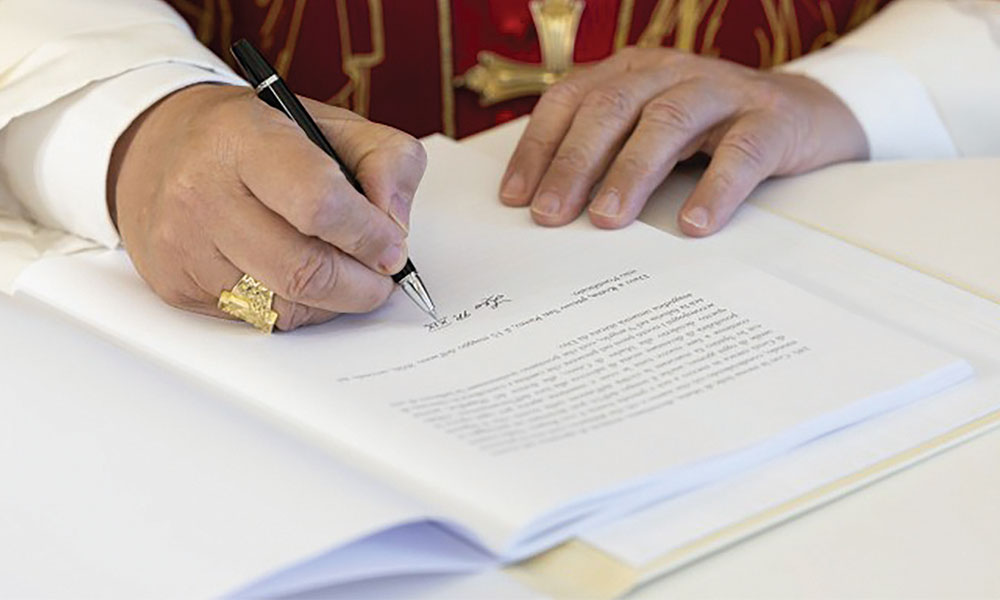
On May 15, 2026 – exactly 135 years later – Pope Leo XIV signed Magnifica Humanitas (“Magnificent Humanity”), his first encyclical and the first major papal document on safeguarding the human person in the age of artificial intelligence. The pope released the 42,000-word encyclical on May 25.
Here are five things you should know:
Pope Leo doesn’t oppose AI, but …
Artificial intelligence must be placed at the service of human flourishing, the Holy Father writes. As the res novae – or revolution – of our time, the possibilities and risks associated with AI, robotics and digitization are real and imminent, representing an “epochal change” for humanity. While the technology should neither be feared nor rejected, the questions it poses for humanity challenge the conscience, he writes: “We must ask God for the wisdom to interpret the great trends of our time, particularly technological advances.” (MH 4)
Drawing upon biblical themes and Christian thinkers such as J.R.R. Tolkien, Dorothy Day and St. Augustine, as well as his papal predecessors, Pope Leo underscores the need to wisely discern and apply the Church’s social teaching in every age.
Humanity is at an inflection point
As is custom, the encyclical’s title – Latin for “Magnificent Humanity” – comes from the document’s opening words. But it’s also a fitting theme for Pope Leo’s vision woven throughout. While artificial intelligence promises exponential leaps in efficiency and productivity, it must not come at the expense of the human person, who is uniquely made in God’s image, the pope says. “Technology is not simply a tool. When it becomes the standard by which everything is judged, it begins to dictate what matters and what can be discarded, reducing creation to an object of exploitation and human beings to mere cogs in a system driven toward ever greater efficiency.” (MH 92)
The pace of technological advancement places humanity at a crossroads, Pope Leo writes. Comparing the moment to the biblical Tower of Babel, which humans constructed as a way to sideline God, Leo challenges today’s leaders to avoid “Babel syndrome,” which he describes as “the idolatry of profit that sacrifices the weak” (MH 10) and uses people as means to be optimized, instead of divinely created ends. “The primary choice is not between a ‘yes’ or ‘no’ to technology, but rather between constructing Babel or rebuilding Jerusalem; between a power that claims to dominate the heavens and a people who work together in the presence of God to rebuild the walls of fraternal coexistence.” (MH 9)
Like all things, human dignity comes first
As AI rapidly advances into nearly all corners of society, it’s critical for leaders, governments, families and industries to consider its impact on human dignity, flourishing and freedom, the pope writes – even if it means slowing down. The specter of widespread unemployment – which would be a “true social calamity” – is even more insidious when “innovation is often pursued solely for reducing costs and increasing profits,” he writes (MH 151).
Magnifica Humanitas discusses the impact of AI and technology on education, parenting, psychological wellbeing, communication, imagination, economic security, the environment and more. It contains warnings about digital addiction and “new forms of slavery,” including sexual exploitation and human trafficking – and even a historic apology for the Church’s role in tolerating forms of slavery in the past. The word “dignity” appears in the document 105 times: “If technology promises emancipation, yet produces new forms of global subordination, it stands in contradiction to the fundamental principle of human dignity.” (MH 173)
Prudence and responsibility go a long way
Regarding AI, Pope Leo writes that “three aspects in particular deserve careful consideration: the ease with which results are obtained, the impression of objectivity and the simulation of human communication.” (MH 100)
• While AI can make complex tasks vastly simpler, it risks weakening human creativity and judgment – and even diluting objective truth – if excessively relied upon, the document states.
• While AI systems might seem objective, it’s easy to “overlook the fact that they reflect the cultural assumptions of those who designed and trained them.” (MH 100) Artificial intelligence cannot be considered “morally neutral,” the pope adds, when “that morality is determined by a few.” (MH 107)
• AI also poses a special risk to the vulnerable – particularly young and emotionally distressed individuals – who, in engaging with chatbots in simulated conversations, “may gradually lose the very desire to form genuine human connections.” (MH 100)
For these reasons, it’s incumbent upon all who develop, regulate and use the technology to set limits, act with prudence, and safeguard the common good, he writes.
AI and modern warfare
Pope Leo devotes the entire fifth chapter of Magnifica Humanitas to the clash between “the culture of power and the civilization of love,” which reaches a crescendo when technology enables new and dangerous forms of warfare. Drones, autonomous weapons and AI-powered weaponry can reduce moral judgment to “calculation,” he writes, blurring the human consequences of war and “transforming defense into threat prediction and thus reducing victims to data.” (MH 198)
The deadly efficiency with which machines can kill – and the temptation to use them to amass control – has given way to a “culture of power” in which moral judgment is replaced by strategic expediency, the pope writes. For this reason, apart from strict self-defense, he writes that the “’just war’ theory, which has all too often been used to justify any kind of war, is now outdated” (MH 192); “no algorithm can make war morally acceptable.” (MH 198)
In contrast, Pope Leo calls on Christians to “build the civilization of love,” emulating Christ and the saints in promoting peace through dialogue, justice and love. “The civilization of love will not arise from a single or spectacular gesture, but from the sum total of small and steadfast acts of fidelity that serve as a bulwark against dehumanization.” (MH 213)
Michael Stechschulte is the director of digital media for the Archdiocese of Detroit and editor-in-chief of its digital publication, Detroit Catholic.